Eagle Arms (Garudasana Arms): How to Practise, Benefits, Modifications and Common Mistakes
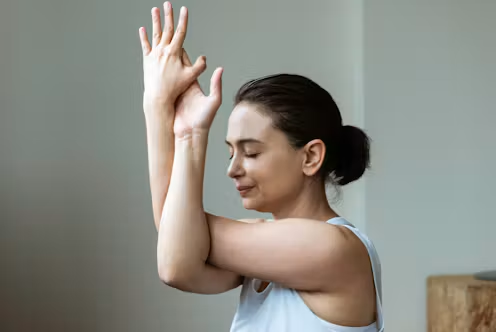
Eagle Arms, also known as Garudasana Arms, is a yoga arm position in which the arms cross in front of the chest, the elbows bend and the forearms wrap towards each other. It is commonly practised as part of Eagle Pose (Garudasana), but can also be performed independently while standing, sitting on the floor or seated in a chair.
The position primarily stretches the shoulders and upper back, particularly the area between the shoulder blades. It also encourages practitioners to become more aware of how they hold tension through their neck, shoulders and upper body.
Eagle Arms is one of those movements that can feel surprisingly satisfying after a long day at a desk. The action of wrapping the arms around each other creates a stretch across areas of the upper back that can be difficult to reach through conventional shoulder movements. It also requires considerably less preparation than many other yoga postures, making it relatively easy to incorporate into a home practice.
Having practised yoga for close to a decade, both at home and in studios, I have come to appreciate these smaller movements that are easily overlooked in favour of more elaborate poses. Eagle Arms is a good example. It often appears briefly during a Vinyasa class, usually as a preliminary movement before progressing into the full standing Eagle Pose, but the arm position is worth exploring on its own.
There is also more to the posture than simply twisting the forearms together. The position of the shoulders, the way the elbows move and the amount of tension held in the hands can all influence how the stretch feels. For some practitioners, the full arm wrap is relatively straightforward. Others may find that their forearms do not comfortably meet, particularly if they have restricted shoulder mobility.
Fortunately, achieving the complete bind is not necessary to benefit from the movement. A simpler variation can provide a similar upper-back stretch without forcing the shoulders or wrists into an uncomfortable position.
Eagle Arms at a Glance
| Field | Details |
|---|---|
| English name | Eagle Arms |
| Sanskrit name | Garudasana arm position (गरुडासन) |
| Also known as | Garudasana Arms, Eagle Pose Arms, Eagle Arm Stretch |
| Pose category | Seated or standing upper-body stretch; arm variation of Eagle Pose |
| Difficulty level | Beginner-friendly with modifications; full arm bind may be challenging |
| Primary focus areas | Shoulder mobility, upper-back stretching, shoulder blade movement, postural awareness |
| Secondary areas involved | Rear shoulders, trapezius, rhomboids, upper arms, elbows and wrists |
| Common props | Yoga chair, folded blanket or meditation cushion for seated support; wall for standing support |
| Typical uses | Upper-body warm-ups, shoulder mobility practice, yoga sequencing, preparation for full Eagle Pose |
| Preparatory poses | Mountain Pose, Easy Pose, gentle shoulder rolls, Cow Face Arms |
| Common alternatives | Self-Hug Stretch, single arm cross, seated Eagle Arms, supported shoulder stretch |
| Key caution | Avoid forcing the forearms or palms together, particularly if you experience shoulder, elbow, wrist or neck pain |
What Are Eagle Arms in Yoga?
Eagle Arms refers to the distinctive arm arrangement used in Garudasana, the traditional standing balance posture commonly known as Eagle Pose.
The Sanskrit name Garudasana comes from Garuda, a powerful mythical bird associated with Hindu and Buddhist traditions, and asana, meaning seat or posture. Garuda is particularly well known in Hindu mythology as the mount of Vishnu.
Although the complete posture combines an arm bind with crossed legs and a balancing position, the arm arrangement is frequently taught separately. This allows students to explore the movement through the shoulders and upper back without simultaneously having to maintain their balance.
Strictly speaking, Eagle Arms is not generally treated as a separate classical asana with its own distinct Sanskrit name. It is better understood as the upper-body component or variation of Garudasana.
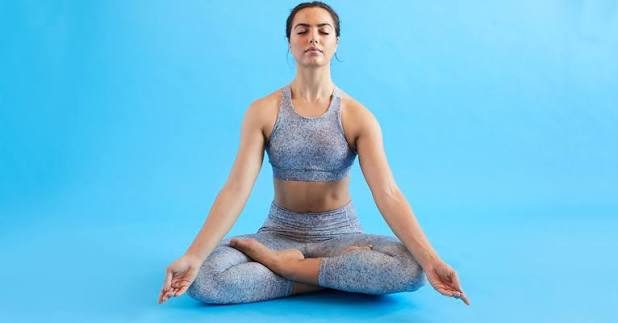
In a typical studio class, an instructor may introduce Eagle Arms while students are seated in Easy Pose (Sukhasana), standing in Mountain Pose (Tadasana) or preparing to enter the full balancing posture.
The movement is also commonly incorporated into yoga warm-ups because it encourages the shoulder blades to move apart and stretches tissues across the upper back.
Its accessibility is part of the appeal. Unlike many yoga postures that require considerable strength, balance or lower-body mobility, Eagle Arms can be practised without changing the position of the legs at all.
However, accessibility should not be confused with universal comfort. The full arm wrap requires a combination of shoulder movement and forearm positioning that may not be available to everyone.
How to Do Eagle Arms (Garudasana Arms)
Eagle Arms can be practised while sitting or standing. If you are new to the position, beginning in a comfortable seated posture removes the need to think about balance and allows you to concentrate on the movement of the arms.
Step-by-step instructions
- Begin in a comfortable upright position. Sit cross-legged on a yoga mat, use a meditation cushion or stand with your feet approximately hip-width apart. Allow your spine to lengthen naturally and keep your shoulders relaxed.
- Extend both arms forwards. Bring your arms in front of your body at approximately shoulder height, with the palms facing each other.
- Cross your right arm over your left. Allow the upper arms to cross in front of your chest. The right elbow will sit above or slightly in front of the left upper arm, depending on your proportions and available mobility.
- Bend both elbows. Bring the forearms upwards so that your fingers point towards the ceiling. At this stage, you may already feel a stretch across the upper back.
- Bring the hands towards each other. If comfortable, allow the forearms to wrap farther until the backs of the hands meet. Practitioners with sufficient mobility may be able to bring their palms together.
- Adjust the elbows gently. Allow the elbows to move slightly forwards or upwards until you feel a comfortable stretch across the shoulders and upper back. Avoid lifting them so high that your neck or shoulders begin to strain.
- Relax unnecessary tension. Keep your neck comfortable, avoid gripping through the fingers and allow your breathing to remain natural.
- Hold for a few breaths. Remain in the position for approximately three to five comfortable breaths, or less if you begin to feel discomfort.
- Release the arms slowly. Unwrap the forearms, lower your hands and allow your shoulders to relax before repeating the movement with the left arm crossed over the right.
If the palms do not meet comfortably, there is no need to force them together. Simply crossing the upper arms, bending the elbows or placing the hands on the opposite shoulders may provide an effective variation.
The purpose of the movement is to explore a comfortable stretch, not to create the tightest possible bind.
Understanding the Anatomy of Eagle Arms
Although Eagle Arms is often described as a shoulder-opening posture, the movement is somewhat different from the broad, chest-opening stretches commonly associated with yoga.
When the arms cross in front of the chest, the shoulders move into horizontal adduction, bringing the upper arms across the body.
As the arms wrap, the shoulder blades can move away from the spine through a movement known as scapular protraction.
This creates a stretching sensation across the upper back, particularly in the muscles between and around the shoulder blades.
The rhomboids and middle trapezius are among the muscles that may experience stretching as the shoulder blades move apart. The posterior shoulder muscles can also be involved, depending on the position of the upper arms.
The exact sensation varies with individual anatomy, arm proportions and mobility.
For some practitioners, the stretch is most noticeable between the shoulder blades. Others feel it more strongly around the backs of their shoulders or upper arms.
This is one reason the full arm bind can be misleading as a measure of flexibility. Being able to press the palms together depends on several factors, including the range of movement available at the shoulders and the relative lengths of the arms and forearms.
Someone may experience a substantial upper-back stretch while their hands remain separated.
Conversely, a practitioner who can wrap the arms easily may need to adjust the position slightly to feel the intended movement.
The aim should be to find a comfortable relationship between the shoulders, elbows and upper back rather than trying to reproduce one precise appearance.
What Are the Benefits of Eagle Arms?
Eagle Arms is frequently included in yoga sequences because it offers a relatively accessible way to explore upper-body movement.
Its benefits are primarily related to stretching, mobility and body awareness rather than strength development or treatment of a particular medical condition.
1. Stretches the upper back
The arm wrap encourages the shoulder blades to move apart, creating a stretch through the muscles of the upper back.
This can feel particularly pleasant after spending considerable time with the arms positioned in front of the body, such as when working at a computer.
However, it is worth distinguishing the temporary sensation of relief from a lasting improvement in posture or chronic pain. Eagle Arms may be a useful movement break, but it should not be presented as a treatment for persistent back discomfort.
2. Encourages shoulder mobility
The position involves movements through the shoulders that may not feature prominently in everyday activity.
Practising within a comfortable range can help students become more familiar with how their shoulders move and where they experience restrictions.
However, the ability to achieve the full bind is not a reliable measure of overall shoulder health or mobility.
3. Develops awareness of shoulder blade movement
Many people have relatively little awareness of how their shoulder blades move independently of the arms.
Eagle Arms provides an opportunity to observe the sensation of the shoulder blades moving apart as the arms cross in front of the chest.
This can be useful for practitioners learning more about upper-body mechanics, particularly when combined with other movements that explore different directions of shoulder and scapular motion.
4. Provides a gentle pause during yoga practice
Eagle Arms can be incorporated into a seated practice or used as a brief movement between more demanding postures.
Because the arms remain relatively still once the position has been established, practitioners can focus on breathing and observing the sensations through the upper body.
This may be particularly useful in slower Hatha classes or during the early stages of a Vinyasa warm-up.
5. Prepares the upper body for full Eagle Pose
Practising the arm position separately allows students to become familiar with the wrap before adding the challenge of balancing on one leg.
This can make the complete Garudasana easier to coordinate, particularly for beginners who find it difficult to concentrate on both the upper and lower body at the same time.
However, being comfortable with Eagle Arms does not automatically mean that someone is prepared for the full standing balance.
Common Mistakes in Eagle Arms
1. Forcing the palms together
One of the most common mistakes is assuming that the hands must meet for the posture to be correct.
Some practitioners can bring their palms together relatively easily, while others find that their shoulders or forearms do not comfortably accommodate the position.
Attempting to force the bind may create unnecessary tension through the wrists, elbows or shoulders.
How to correct it: Begin with the upper arms crossed and the elbows bent. If the backs of the hands meet comfortably, remain there. Only move towards a palm-to-palm position if it happens naturally without pain or strain.
2. Lifting the shoulders towards the ears
As the elbows rise, it is easy to lift the shoulders and create tension around the neck.
This can make the posture feel more demanding than intended, particularly when the practitioner is concentrating on keeping the forearms tightly wrapped.
How to correct it: Keep the elbows at a comfortable height and allow the neck to remain relaxed. You do not need to force the shoulders down into a rigid position, but excessive shrugging is usually unnecessary.
3. Rounding the entire upper body
Eagle Arms involves movement through the shoulder blades, which can create a natural sensation of widening across the upper back.
However, some practitioners exaggerate this movement by collapsing the chest and rounding the entire torso forwards.
This may change the intended stretch and make breathing less comfortable.
How to correct it: Maintain a comfortable, upright seated or standing position while allowing the shoulder blades to move naturally. A small amount of spinal rounding may be intentional in certain variations, but it is not necessary to force the entire torso forwards.
4. Lifting the elbows too high
Many instructions encourage students to lift the elbows to approximately shoulder height.
While this can be a useful reference point, some practitioners interpret it as a requirement to raise the elbows as high as possible.
This may introduce unnecessary discomfort, particularly when shoulder mobility is limited.
How to correct it: Raise the elbows only until you feel a comfortable stretch. If keeping them slightly lower allows your neck and shoulders to relax, that variation may be more appropriate.
5. Holding the breath
Because the full wrap can feel restrictive, practitioners may unconsciously hold their breath while trying to maintain the position.
This often happens when too much attention is placed on achieving the shape of the posture.
How to correct it: Once the arms are crossed, allow your breathing to settle into a natural rhythm. If you find yourself straining or repeatedly holding your breath, loosen the bind or return to a simpler variation.
6. Forgetting to practise both sides
Most people have differences in mobility between the left and right sides of their bodies.
Eagle Arms may feel considerably easier with one arm crossed over the other, particularly if one shoulder is more restricted.
Practising only the more comfortable side can mean overlooking these differences.
How to correct it: Repeat the movement with both arm positions, without forcing them to feel or look identical. The amount of stretch and elbow height may differ between sides.
Eagle Arms Modifications and Variations
Self-Hug Eagle Arms
The self-hug variation is one of the simplest alternatives to the full arm bind.
Cross both arms over the chest and place your hands on the opposite shoulders, as though giving yourself a hug.
Allow the elbows to move slightly forwards, creating a comfortable stretch across the upper back.
This variation is particularly useful for beginners and practitioners who experience discomfort when attempting to wrap their forearms together.
It also allows greater flexibility in positioning the hands and elbows.
Eagle Arms With the Backs of the Hands Together
If you can comfortably cross the upper arms and bend the elbows but cannot bring the palms together, try allowing the backs of the hands to meet.
This offers a variation between the self-hug position and the full arm wrap.
There is no requirement to progress beyond it, particularly if you already feel an appropriate stretch through the upper back.
Seated Eagle Arms
Practise Eagle Arms while sitting cross-legged on the mat or on a meditation cushion.
The seated position allows you to concentrate on the upper-body movement without needing to maintain a standing posture.
A folded blanket beneath the hips may help if sitting upright on the floor feels uncomfortable.
Chair-Seated Eagle Arms
Sit in a stable chair with your feet supported on the floor.
Cross the arms in front of the chest and explore the same movement without changing your lower-body position.
This variation can be especially convenient for home or office practice, and for people who prefer not to sit on the floor.
Standing Eagle Arms
Begin in Mountain Pose with your feet approximately hip-width apart.
Perform the arm wrap while maintaining a comfortable upright stance.
This variation is useful during standing yoga sequences or as preparation for the full balancing posture.
Eagle Arms With Gentle Movement
Once you are comfortable with the basic arm position, you may experiment with small movements.
For example, you might gently raise and lower the elbows within a pain-free range, observing how the sensation changes across the shoulders and upper back.
Some classes also incorporate slight spinal rounding or side-to-side movement while maintaining the arm wrap.
These variations should be introduced gradually rather than treated as a way to intensify the stretch indefinitely.
Eagle Arms vs Full Eagle Pose: What Is the Difference?
Although Eagle Arms and Eagle Pose share the same arm position, they are not interchangeable exercises.
Full Eagle Pose (Garudasana) is a standing balance that combines crossed arms with a corresponding wrap of the legs.
The complete posture requires balance, lower-body strength, coordination and mobility through several joints.
Eagle Arms isolates the upper-body component, allowing practitioners to explore shoulder movement without the additional demands of balancing.
This makes it a useful preparatory exercise, particularly for students who are still becoming familiar with Garudasana.
It also makes Eagle Arms suitable for people who do not want to practise a standing balance or who have lower-body limitations that make the complete posture unsuitable.
You do not need to progress from Eagle Arms into full Eagle Pose for the movement to be worthwhile.
Can Eagle Arms Help With Tight Shoulders From Desk Work?
Eagle Arms is often recommended as a simple movement for people who spend long periods sitting at computers.
There is a practical reason for this recommendation. Working at a desk frequently involves holding the arms in front of the body for extended periods, with relatively little variation in shoulder position.
Taking a break to move the arms in different directions can provide a welcome change from a static working posture.
Eagle Arms may feel particularly satisfying because the movement stretches across the upper back and encourages awareness of the shoulders.
However, it is important not to exaggerate its effects.
There is limited evidence that Eagle Arms, considered as an isolated movement, can independently correct posture, prevent neck pain or resolve chronic shoulder tension.
Persistent discomfort may involve several factors, including workstation setup, activity levels, stress, existing injuries and individual movement habits.
Rather than treating Eagle Arms as a cure for desk-related pain, it is more reasonable to consider it one of several gentle movements that can be incorporated into regular breaks.
It may also be useful to alternate between different directions of movement, including gentle shoulder rolls, arm raises and comfortable chest-opening stretches.
Is Eagle Arms Safe for Everyone?
Eagle Arms is relatively accessible because it does not require weight-bearing through the arms or balancing on one leg.
Nevertheless, the full arm bind may be uncomfortable for people with particular shoulder, elbow, wrist or neck conditions.
Those recovering from upper-body injuries or surgery should seek appropriate professional guidance before attempting movements that place significant demands on the affected joints.
Practitioners with existing shoulder pain should be especially cautious about forcing the arms across the chest or attempting a deeper wrap.
A stretching sensation across the upper back may be comfortable, but sharp pain, numbness, tingling or symptoms travelling into the arms or hands should not be ignored.
If these sensations occur, release the position rather than attempting to deepen the stretch.
It is also worth remembering that the full arm wrap is not essential. A self-hug variation may provide a gentler alternative, although even that should be avoided if it reproduces pain.
An experienced yoga instructor can help adapt the movement within their professional scope, but persistent symptoms require appropriate medical assessment.
How Long Should You Hold Eagle Arms?
There is no universally ideal duration for holding Eagle Arms.
In a typical yoga class, the position may be maintained for three to five breaths before switching sides.
For someone using the movement as a brief upper-body stretch during the day, a short comfortable hold may be sufficient.
Longer holds are not automatically more beneficial, particularly if the shoulders or arms begin to feel uncomfortable.
As with many yoga postures, the quality of the position is more important than how long you remain in it.
If you find yourself gripping the hands tightly, holding your breath or straining through the neck, it may be time to release the posture.
When practising on both sides, aim for a similar amount of time while allowing for differences in comfort.
How to Include Eagle Arms in Your Yoga Practice
One of the advantages of Eagle Arms is that it can be incorporated into several different styles of yoga without requiring a complicated sequence.
During a Hatha Yoga class, it may be used as part of a seated warm-up alongside shoulder rolls, arm raises and gentle spinal movements.
In Vinyasa Yoga, the arm wrap often appears before full Eagle Pose or as a transitional movement between standing postures.
Some instructors also include Eagle Arms in Chair Pose (Utkatasana), allowing practitioners to combine the upper-body stretch with lower-body strengthening.
For a slower home practice, it can be paired with Easy Pose or another comfortable seated position.
A simple sequence might begin with a few gentle shoulder rolls, followed by a self-hug stretch, Eagle Arms on both sides and then a comfortable chest-opening movement.
This combination allows the shoulders to move through different directions rather than repeatedly stretching the same area.
It is equally reasonable to practise Eagle Arms on its own, particularly when you want a brief break from sitting.
Who May Benefit Most From Eagle Arms?
Eagle Arms may appeal to practitioners who want an accessible upper-body stretch without requiring extensive yoga experience.
It is particularly useful for those interested in exploring shoulder blade movement, developing awareness of upper-body tension or preparing for the arm position used in full Eagle Pose.
People who spend considerable time sitting may also appreciate the opportunity to move their shoulders through a different range.
For beginners, the posture provides an introduction to the idea that yoga movements can be modified without losing their purpose.
The full arm bind may look like the intended destination, but practitioners can experience a meaningful stretch simply by crossing the arms in front of the chest.
For experienced practitioners, Eagle Arms remains useful as a warm-up or as part of a broader mobility practice.
Its value does not necessarily increase with the complexity of the variation performed.
Our Editorial Verdict
Eagle Arms is a good example of a relatively simple yoga movement that deserves more attention than it usually receives.
In many studio classes, the arm wrap is introduced briefly before students progress into the full standing Eagle Pose. Because the balancing posture is more visually demanding, it tends to attract most of the attention.
Yet the upper-body movement can be useful in its own right, particularly for practitioners who spend substantial amounts of time sitting or who want to explore how the shoulder blades move.
What I appreciate about Eagle Arms is that it does not require the full bind to feel worthwhile. A straightforward self-hug may create an effective stretch across the upper back, while a seated variation removes the need to concentrate on balance.
The main consideration is avoiding the tendency to treat the completed arm wrap as evidence of better mobility or technique. Some practitioners can bring their palms together easily, while others find that their proportions or shoulder mobility make the position less accessible.
Neither experience necessarily reflects the quality of the practice.
I would also be cautious about the common claim that Eagle Arms can correct poor posture or eliminate shoulder tension caused by desk work. Although the stretch may feel pleasant, longer-term musculoskeletal discomfort is more complicated than a single yoga movement can address.
Our take: Eagle Arms is a useful addition to both beginner and experienced yoga practices, particularly as an upper-back stretch and introduction to shoulder blade movement. It is easy to incorporate into seated routines, warm-ups and short movement breaks, but the complete arm bind should never be forced. A comfortable self-hug or partial wrap is preferable to an impressive-looking position that creates strain.
Frequently Asked Questions
What is Eagle Arms in yoga?
Eagle Arms is the upper-body component of Eagle Pose (Garudasana). It involves crossing the arms in front of the chest, bending the elbows and wrapping the forearms towards each other. The movement is commonly used to stretch the shoulders and upper back.
What is the Sanskrit name for Eagle Arms?
Eagle Arms is usually referred to as Garudasana Arms or the Garudasana arm position. Garudasana is the Sanskrit name for the full Eagle Pose. Eagle Arms is generally treated as a variation or component of that posture rather than a separate classical asana.
What muscles does Eagle Arms stretch?
Eagle Arms primarily creates a stretching sensation across the shoulders and upper back. Depending on the position, this may involve the rhomboids, middle trapezius and posterior shoulder muscles.
Can beginners do Eagle Arms?
Yes. Beginners can practise a simplified variation by crossing the arms over the chest and resting the hands on the opposite shoulders. The full forearm wrap is not necessary.
Why can’t I bring my palms together in Eagle Arms?
The ability to bring the palms together depends on shoulder mobility, arm proportions and other anatomical factors. If the full bind is uncomfortable, keep the backs of the hands together or use a self-hug variation instead.
Is Eagle Arms good for shoulder tension?
Eagle Arms may provide a comfortable stretch across the shoulders and upper back, particularly after periods of limited movement. However, it should not be regarded as a treatment for persistent shoulder pain or an underlying medical condition.
Should your elbows be at shoulder height in Eagle Arms?
Shoulder height is a common alignment reference, but it is not a universal requirement. The elbows should remain at a height that allows the shoulders and neck to stay comfortable.
How long should I hold Eagle Arms?
Three to five relaxed breaths per side is a common starting point. The appropriate duration depends on comfort, and the posture should be released if pain, numbness or increasing strain develops.
Can Eagle Arms be practised while sitting in a chair?
Yes. Chair-Seated Eagle Arms is a convenient variation that allows practitioners to focus on the shoulders and upper back without needing to sit on the floor or maintain a standing balance.
Is Eagle Arms the same as Eagle Pose?
No. Eagle Arms refers only to the upper-body arrangement, whereas full Eagle Pose combines the arm wrap with crossed legs and a standing balance.
Editorial Research and Sources
Research and methodology: This guide was prepared using established yoga teaching resources covering Garudasana, its arm variations, shoulder movement and practical modifications. Particular attention was given to the difference between a comfortable upper-back stretch and forcing the full arm bind.
Editorial experience: The article is informed by the editor’s close to a decade of yoga practice at home, through online classes and across different studios, alongside ongoing research into yoga teaching methods and teacher training programmes.
Primary and authoritative sources:
https://www.yogajournal.com/poses/eagle-pose
https://www.yogajournal.com/practice/ways-to-practice-eagle-arms
https://yogavastu.com/p/garudasana-arms
https://www.nccih.nih.gov/health/yoga-effectiveness-and-safety
Editorial note: This article provides general yoga education and does not replace individual instruction or professional medical assessment. Practitioners with existing shoulder, neck, elbow or wrist conditions should seek appropriate guidance before attempting demanding arm positions.
Last reviewed: 4 November 2026
Key details
| Sanskrit Name | Garudasana arms |
|---|---|
| Pose Family | Shoulder |
| Level | Beginner |
| Focus Areas | Upper-back mobility |
| Teaching Focus | Wrap arms only as far as comfortable |
| Entry Steps | Review the starting position and teach a gradual entry suited to the student |
| Exit Steps | Return gradually and pause if uncomfortable |
| Modifications | Hug shoulders |
| Safety Notes | Avoid pressure at elbows |
| Props | Block; strap; blanket; wall or chair as appropriate |
| Breathing | Keep the breath steady; do not force breath retention |
| Common Mistakes | Chasing a visual shape instead of respecting individual range |
| Duration Guidance | No fixed universal hold; adjust to experience and comfort |