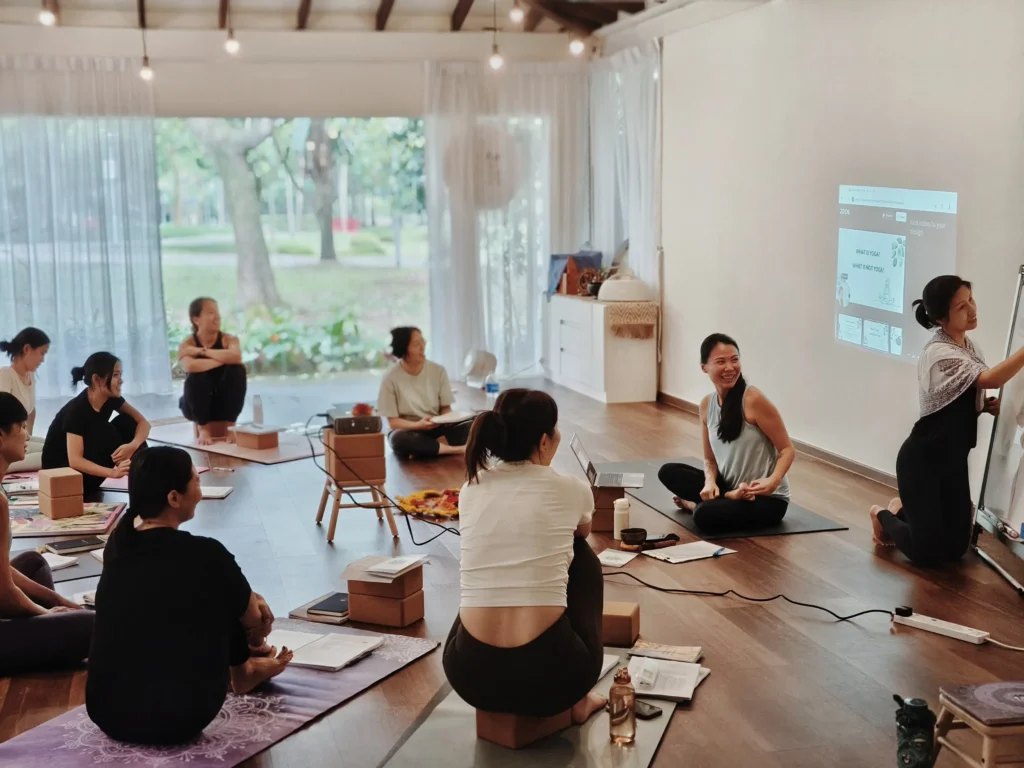
Yoga Seeds offers a 200-hour Yoga Teacher Training (YTT) programme at its studio within Aramsa – The Garden Spa, located in Bishan–Ang Mo Kio Park. The foundational course is intended for practitioners who want to deepen their understanding of yoga, explore its philosophical and anatomical foundations, or develop the skills needed to begin teaching.
The school has published two 2027 intakes, running from 6 March to 25 April and 3 July to 29 August. Both are structured around eight weekends of in-person training, supported by weekday self-learning and online course materials. This makes Yoga Seeds an option for working adults who cannot commit to a continuous residential training programme but are comfortable dedicating several consecutive weekends to their studies.
The 200-hour curriculum covers asana, pranayama, meditation, yoga philosophy, anatomy, physiology and teaching methodology. Students are also required to complete assignments, assessments and a practical teaching examination before receiving their certificate.
Training takes place at Yoga Seeds’ shala in Bishan Park, where the surrounding greenery provides a different setting from the commercial studios commonly associated with yoga classes in Singapore. The school also offers advanced teacher training and continuing education modules, which may appeal to students considering further qualifications after their foundational course.
What stands out about Yoga Seeds’ 200-hour teacher training?
One of Yoga Seeds’ more distinctive features is its approach to combining a foundational teacher training curriculum with a broader emphasis on personal practice, philosophy and mindfulness.
The programme is designed to accommodate both aspiring instructors and practitioners who have no immediate intention of teaching. This distinction matters because not everyone enrolling in a 200-hour YTT is necessarily looking for a career change. Some students simply want to understand the principles behind the postures they have been practising for years, while others are more interested in exploring yoga beyond its physical aspects.
Yoga Seeds explicitly welcomes both groups, although everyone is expected to participate in practice teaching and complete the relevant assessments.
The school’s training faculty is another consideration. Its founder and lead trainer, Wendy Chan, draws on classical yoga, Vinyasa, Yin Yoga and meditation traditions. The wider faculty includes teachers with backgrounds in anatomy, philosophy and different styles of physical practice.
What also stands out is the complimentary access to Yoga Seeds’ regular shala classes throughout the training period. This gives trainees opportunities to maintain a personal practice and observe how experienced instructors structure and deliver classes. However, attending additional classes should not be confused with receiving additional supervised teaching practice.
A closer look at the curriculum
Yoga techniques, asana and pranayama
The practical component introduces students to yoga postures, breathing techniques, meditation and kriyas, or traditional cleansing practices.
Asana training examines alignment, breathing and sequencing, with attention to both the structural and energetic aspects of practice. This is important for students transitioning from simply following a yoga class to understanding why particular postures are taught, how they relate to one another and how they might be adapted for different participants.
Peculiarities in individual anatomy are especially relevant to teaching. Two practitioners may look very different in the same posture without either performing it incorrectly, and learning to recognise these differences is an important part of developing an informed teaching approach.
Prospective students should ask how Yoga Seeds approaches individual anatomical variation, the use of props and adjustments, particularly for people with limited mobility or pre-existing injuries.
The inclusion of pranayama and meditation also allows trainees to examine elements of yoga that are sometimes given relatively little attention in contemporary fitness-oriented classes. These practices require thoughtful instruction, especially when certain breathing techniques may not be suitable for every participant.
Anatomy and physiology
Yoga Seeds includes a dedicated anatomy and physiology component covering the body’s major physiological systems and musculoskeletal structures.
For prospective instructors, the value of anatomy education lies in how effectively it can be applied to teaching. Memorising muscle names and skeletal structures is useful, but understanding how joints move, how different bodies respond to the same posture and when a movement may need to be modified is arguably more relevant in an actual class.
The school’s published curriculum places anatomy within the context of personal practice and teaching, which suggests an applied rather than purely theoretical approach.
However, students should clarify how much practical movement analysis is included, whether common injuries and contraindications are discussed, and how the school distinguishes general movement education from medical advice.
A foundational teacher training course can improve a person’s understanding of movement, but it does not qualify graduates to diagnose injuries or provide therapeutic treatment.
Yoga philosophy and lifestyle ethics
Yoga Seeds places considerable emphasis on the philosophical foundations of yoga. Its curriculum includes the origins and evolution of yoga, ethical principles and the relevance of traditional teachings to contemporary life.
Students study foundational texts such as Patanjali’s Yoga Sutras and the Bhagavad Gita. These provide opportunities to consider yoga as something broader than a collection of physical exercises.
This aspect of training may be particularly interesting to practitioners who have spent years attending asana-based classes without being introduced to the philosophical traditions behind them.
Understanding these texts can also encourage a more thoughtful approach to teaching. Rather than reducing yoga philosophy to inspirational phrases at the beginning or end of a class, students can begin examining the historical and conceptual foundations of ideas frequently referenced in modern yoga communities.
There is, however, a difference between introducing philosophical concepts and studying them in substantial depth. Prospective trainees with a strong interest in traditional yoga philosophy should ask how much instructional time is dedicated to the subject, whether readings are provided and how discussion is incorporated into the course.
Teaching methodology, class planning and sequencing
The teaching component covers communication, class planning, sequencing and techniques for instructing asana, pranayama and kriyas.
Learning to teach requires skills that are not necessarily developed through years of personal yoga practice. Someone may be comfortable performing a wide range of postures yet find it challenging to explain those movements clearly, manage a group of students or adjust the pace of a class when participants have different levels of experience.
Yoga Seeds includes hands-on teaching practice within its curriculum, with a practical examination forming part of the graduation requirements.
This is a useful distinction for prospective students because the school does not present attendance alone as sufficient for certification. Trainees are expected to demonstrate what they have learned through assignments, assessments and practical teaching.
Before enrolling, it would still be worth asking how much individual teaching time each trainee receives, whether feedback is delivered privately or in groups, and how many opportunities students have to practise teaching before their final assessment.
The quality of supervised practice can make a considerable difference to how prepared a new instructor feels after graduation.
Who teaches the Yoga Seeds programme?
Yoga Seeds identifies four members of its teacher training faculty, each bringing a different area of interest and experience to its programmes.
Wendy Chan — Founder and Lead Trainer
Wendy leads the Yoga Seeds teaching faculty and is responsible for designing the school’s training programmes. Her approach draws on classical yoga, Vinyasa, Yin Yoga and meditation, with an interest in integrating philosophical study into physical practice.
Her background may appeal to students who want their teacher training to explore yoga beyond the technical performance of postures.
Joanne Ang — Teacher Trainer
Joanne is listed among the school’s 200-hour and 300-hour teacher training faculty. Her teaching background includes Ashtanga Yoga and an interest in biology, bringing a movement-focused perspective to the wider training team.
Meiyan Cheong — Teacher Trainer
Meiyan is also part of the school’s 200-hour and 300-hour training faculty, with teaching interests spanning Vinyasa Flow and Yin Yoga. This combination is relevant to students interested in understanding both movement-based sequencing and slower, more considered approaches to practice.
Bryan Ng — Anatomy and Philosophy Trainer
Bryan contributes to the school’s anatomy and philosophy education. Yoga Seeds also lists him as a trainer for specialised continuing education courses, including yoga and pain rehabilitation.
Having trainers with different areas of expertise may provide students with a broader range of perspectives, although the actual experience will depend on how the faculty divides teaching responsibilities.
Prospective trainees should confirm which instructors will be teaching their selected intake and how many hours each will deliver.
Is the eight-weekend format suitable for working adults?
Yoga Seeds’ weekend training arrangement may be attractive to Singapore-based students who prefer to continue working while completing their qualification.
The March intake runs from 6 March to 25 April 2027, while the July intake runs from 3 July to 29 August 2027. Both are advertised as eight-weekend courses, rather than consecutive full-time residential intensives.
Students should be aware, however, that the 200-hour programme is not limited to physically attending the shala on weekends. Yoga Seeds states that training also involves weekday self-learning through online content.
This is an important practical consideration. While the format may be more compatible with a full-time job than an overseas intensive, trainees will still need to allocate time outside scheduled sessions for independent learning, assignments and preparation for teaching assessments.
The school’s public timetable identifies the intake dates and a 10:30 a.m. start and 6:30 p.m. finish on the course calendar. Prospective students should request the detailed daily timetable and the breakdown between in-person instructional hours and online learning before planning their schedules.
Attendance requirements also deserve attention. Yoga Seeds encourages students to attend all in-person sessions and advises those who expect to miss an entire weekend or several training sessions to consider another intake.
For unexpected illness, the school states that trainers will try to arrange make-up sessions or provide recordings. This should not be treated as a guarantee that every missed session can be replaced without affecting graduation requirements.
The weekend format gives students time between sessions to absorb what they have learned, but it also requires considerable discipline. Someone who already works long hours during the week may find that eight consecutive weekends of study leave relatively little time for other commitments.
Yoga Seeds 200-hour teacher training fees in 2027
Unlike some training providers that require prospective students to enquire about tuition, Yoga Seeds publishes its fees for both advertised 2027 intakes.
The listed fees are:
- Early-bird tuition: S$3,850
- Standard tuition: S$4,450
- Early-bird savings: S$600
The early-bird rate requires full payment by the applicable deadline. For the March 2027 intake, the published deadline is 23 January 2027. For the July intake, it is 22 May 2027.
The tuition includes the course manual and workbook, access to regular Yoga Seeds shala classes throughout the training period, and the first examination and certification fees.
Additional reference books and separate Yoga Alliance registration fees are not included.
The school also advertises a S$100 Yoga Seeds voucher for qualifying super-early-bird registrations made six months in advance. Students should check the current eligibility conditions before assuming that this promotional benefit applies to their enrolment.
When comparing tuition with other 200-hour programmes in Singapore, it is worth considering more than the headline fee. Course materials, assessment costs, access to supplementary classes and opportunities for supervised teaching may all affect the overall value of a programme.
One additional question worth asking is whether students who need to retake an assessment, defer their studies or attend replacement sessions would incur extra charges. These expenses may not be relevant to every trainee, but understanding them in advance can prevent surprises.
Can beginners enrol in Yoga Seeds teacher training?
Yoga Seeds states that beginners are welcome, although it recommends having approximately three to six months of regular yoga practice before starting the programme.
Students must also be proficient in English, as this is the language used for instruction and assessment.
The relatively accessible entry requirements may appeal to enthusiastic beginners who are interested in exploring yoga in greater depth. Nevertheless, teacher training can feel considerably more demanding than attending a few regular studio classes each week.
Students are expected to study movement, anatomy and philosophy while gradually developing the confidence to demonstrate, explain and teach postures to others. Those who have only recently started practising may benefit from spending additional time attending regular classes before committing to the full course.
It is also worth discussing any physical limitations with the school. Teacher training should not require every participant to demonstrate the most advanced expression of a posture, but applicants should understand the physical demands of the course and how the school accommodates different abilities.
Yoga Alliance certification and graduation requirements
Yoga Seeds advertises its programme as a Yoga Alliance-accredited 200-hour teacher training.
According to the school, students must complete their assignments, assessments and practical teaching examination before receiving their 200-hour completion certificate.
Graduates may subsequently apply for the Registered Yoga Teacher (RYT 200) credential through Yoga Alliance, subject to the organisation’s applicable requirements.
It is important to distinguish the school’s completion certificate from individual RYT registration. Completing an eligible 200-hour programme does not automatically mean that a graduate has become a registered yoga teacher.
Yoga Alliance registration involves a separate application process, and the associated fees are not included in Yoga Seeds’ published course tuition.
Prospective students should verify the school’s current Registered Yoga School status through the official Yoga Alliance directory and confirm that the selected intake qualifies under the relevant registration pathway.
A 200-hour qualification is also best understood as a foundation for teaching, rather than proof of expertise across every yoga discipline. Graduates who intend to teach specialised populations or more advanced classes may need additional training and experience.
Opportunities for further training
Another advantage of considering Yoga Seeds is that its education programmes extend beyond the foundational 200-hour qualification.
The school offers a modular 300-hour advanced teacher training pathway, alongside continuing education courses covering subjects such as prenatal and postnatal yoga, Yin Yoga, anatomy, mindfulness, philosophy, adaptive teaching and Vinyasa sequencing.
This could be relevant to students who want to continue studying with a familiar faculty after completing their first qualification.
Rather than immediately committing to a particular specialisation, graduates may find it useful to spend some time teaching and observing where their interests lie. Practical experience often reveals gaps in knowledge that are less obvious during a foundational training course.
Students interested in eventually pursuing RYT 500 registration should confirm how the school’s advanced training modules are structured, which combinations qualify towards the relevant 300-hour requirement and whether the registration pathway remains compatible with current Yoga Alliance standards.
The existence of further training opportunities is useful, but should not be interpreted as a guarantee of progression, admission or employment.
Who might benefit most from Yoga Seeds’ 200-hour programme?
Yoga Seeds may be particularly suitable for practitioners who want to undertake teacher training in Singapore without stepping away from their weekday employment for an extended period.
The eight-weekend arrangement offers a defined training period, while the online self-learning component provides some flexibility in how students prepare between sessions.
Its curriculum may also appeal to those who are interested in the philosophical and reflective aspects of yoga, rather than focusing entirely on physical postures and teaching sequences.
The Bishan Park setting is another factor that distinguishes the experience from training in a conventional commercial studio. Some students may appreciate studying in a quieter environment surrounded by greenery, although convenience remains important when commuting across Singapore for eight weekends.
The programme may be less suitable for those who prefer entirely online learning, have unpredictable weekend commitments or want to complete their certification during a short residential intensive.
It is also not a specialist course in areas such as yoga therapy, prenatal instruction or rehabilitation. Students interested primarily in those disciplines should examine the school’s advanced modules or compare dedicated qualifications elsewhere.
What should you clarify before enrolling?
Yoga Seeds provides a comparatively useful amount of information about its training fees, prerequisites, assessments and published curriculum. Nevertheless, several details are worth confirming before paying the course fee.
- Actual instructional hours: Request a breakdown of the 200 hours, including live classroom instruction, online learning, supervised teaching and independent study.
- Class size: Ask how many students are accepted into each cohort and how this affects individual feedback.
- Faculty allocation: Confirm which trainers will be present for the selected intake and which subjects each instructor will teach.
- Practical teaching: Establish how many opportunities trainees receive to lead classes or teach sequences before the final examination.
- Assessment criteria: Ask what constitutes a passing performance, how written assignments are assessed and what happens if a student needs to repeat an examination.
- Online learning: Confirm the platform used, whether lessons are live or recorded, and how long students retain access after graduation.
- Missed sessions: Clarify the exact attendance requirement and whether make-up arrangements carry additional fees.
- Payment and refunds: Review deposit requirements, instalment options, cancellation terms and the possibility of transferring to a later intake.
These questions should be considered alongside the student’s individual learning goals. Someone pursuing teacher training as personal enrichment may place greater importance on philosophy and guided practice, while an aspiring instructor may want to prioritise supervised teaching time and the quality of practical feedback.
Neither set of priorities is necessarily better, but they can lead to very different judgements about which programme offers the most suitable experience.
Our editorial verdict
Yoga Seeds presents a well-rounded foundational teacher training programme, combining practical yoga techniques, anatomy, philosophy and teaching methodology within a structured weekend format.
Its approach may be especially appealing to students who want their teacher training to involve more than learning how to demonstrate postures and lead a conventional studio class. The school’s philosophical emphasis, experienced faculty and nature-oriented training environment give it a recognisable identity within Singapore’s yoga education landscape.
We also appreciate that Yoga Seeds publishes its tuition fees and explains its assessment requirements. Prospective students can establish the approximate financial commitment and understand that completing the training involves more than simply attending scheduled sessions.
The complimentary access to regular shala classes is another useful inclusion, particularly for trainees who want to maintain their personal practice throughout the course.
Our main area of interest would be the balance between independent study and supervised instruction. The course combines eight weekends of in-person training with weekday online learning, but prospective students should examine the detailed distribution of hours before comparing it with other 200-hour programmes.
We would also want to understand how much individual teaching practice students receive and how instructors evaluate their progress. These details often have a greater influence on teaching readiness than the number of topics listed in a curriculum.
Our take: Yoga Seeds is worth shortlisting for its combination of foundational yoga education, weekend scheduling and established continuing education offerings. Its Bishan Park setting and emphasis on philosophy may be particularly attractive to practitioners seeking a more reflective learning environment. Before enrolling, we would prioritise clarifying the actual teaching hours, feedback arrangements and workload between weekends, especially for students who hope to begin teaching professionally soon after graduation.
Our directory check and editorial disclosure
Information reviewed: 3 November 2026
This directory entry was prepared using Yoga Seeds’ official 200-hour teacher training pages, published 2027 intake details, faculty information and Yoga Alliance’s guidance on teacher registration.
Course dates, fees, prerequisites, curriculum descriptions, included benefits and assessment requirements are based on the school’s publicly available information. We have not independently attended the training, assessed the quality of instruction, interviewed graduates or verified the number of students admitted to each cohort.
The school’s current Yoga Alliance registration status should be confirmed through the official registry.
Prices, promotions, faculty assignments, programme dates and enrolment conditions may change. Readers should request the latest course brochure and contractual terms directly from Yoga Seeds before making payment.
Official March 2027 programme: https://www.yogaseeds.com.sg/full-calendar/ytt200hr-mar-2027
Official July 2027 programme: https://www.yogaseeds.com.sg/full-calendar/ytt200hr-jul-2027
Yoga Seeds training directory: https://www.yogaseeds.com.sg/trainings
Yoga Alliance: https://yogaalliance.org/